The Airport Shelf Test: What Bookstores Reveal About Business & Behavior
As a social psychologist I know context is everything. While I build out a series reviewing books that bridge behavioral research and modern leadership, I started with an unexpected laboratory, Terminal C at Newark Airport.
This week I found myself at a decently sized Hudson Newsstand. The sections were big enough to have variety but small enough that I could reasonably read each title to gauge the tone of different genres and pick up a few books to start my review series. Here are some musings.
Business vs. Self-Improvement: A Tale of Two Shelves
I began in the business section, where I pulled two books. First, a coaching workbook, called The Coaching Habit, Say Less, Ask More & Change the Way You Lead Forever by Michael Bungay Stanier. Flashy, never more than a few pages of text, many 15-word quotes enlarged to fill a whole page, and a lot of worksheets. Not my typical read but seems fun. Second, John C. Maxwell's classic, Developing the Leader Within You 2.0, celebrating the 25th anniversary of his bestseller through an updated release as 2.0. Maxwell's book seems more my style. Information rich and lots of references!
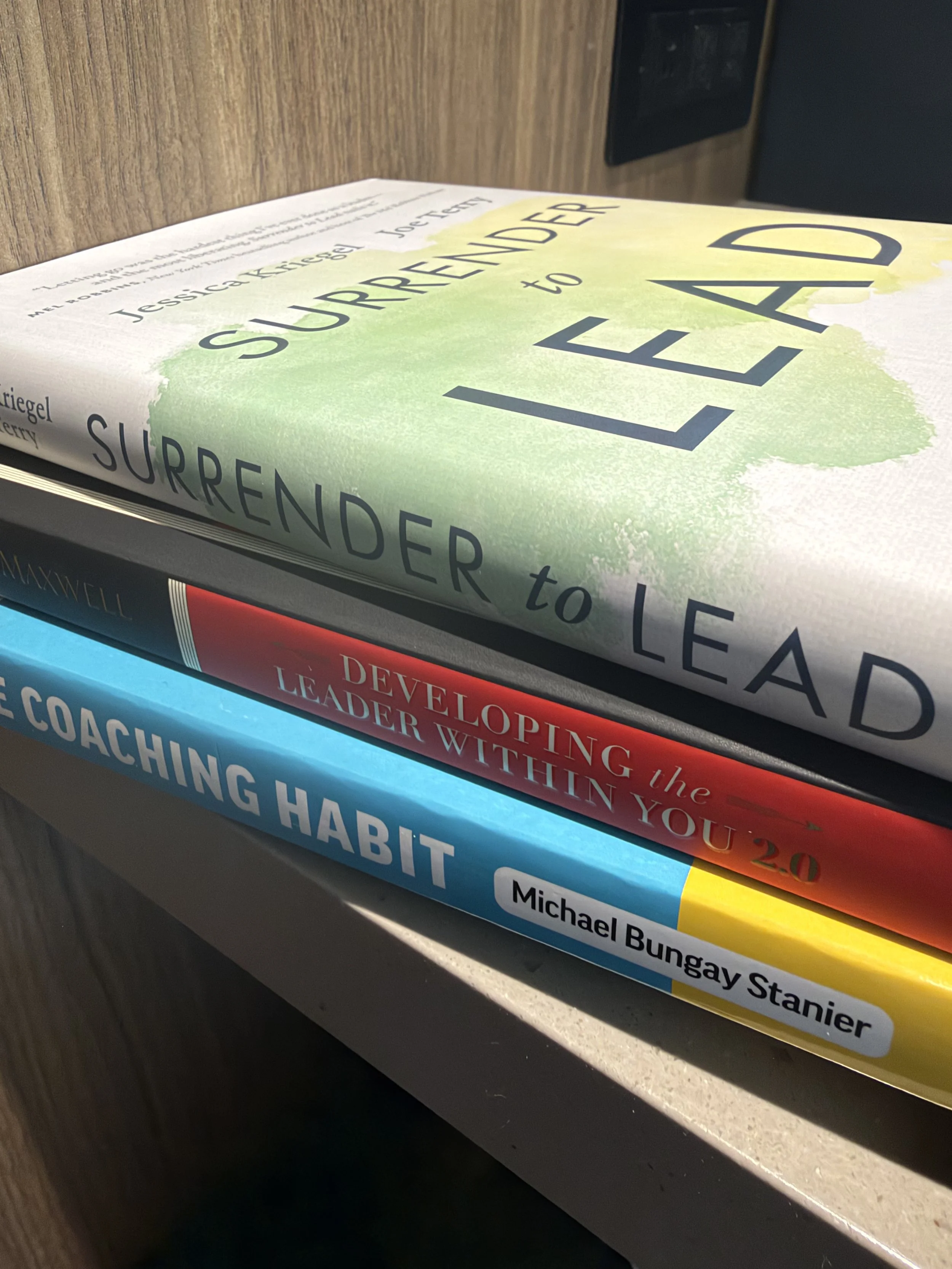
My Hudson Newsstand haul
Then I noticed that both the self-improvement and business sections were displaying Angela Duckworth's New York Times #1 best seller, Grit: The Power of Passion and Perseverance. The cross-categorization makes sense. Some things help your professional life and hurt your personal life. Some do the inverse. Imagining how perseverance leads one to succeed in business as in life isn't hard. But I got to thinking, what leads one book to be filed in self-improvement, and the next in business?
One book I was surprised to find in self-improvement: Jessica Kriegel and Joe Terry's book, Surrender to Lead: The Counterintuitive Approach to Driving Extraordinary Results. Jessica and Joe run Culture Partners, a firm that consults with companies looking to improve their workplace culture. What could be more suited to business? And yet here it was. I picked up their book as well, thinking to round out of the other two. Good things come in threes!
Social Self vs. professional Self
With three new books under my arm, I couldn't help but wonder, why are some books under self-improvement instead of business? The difference between the two sections is clear. In one, leadership advice is sandwiched between dating, self-actualization, and weight loss. The target of these is what social psychologists call our social self. Who we are in relation to other people, to the groups we belong to, and how we are perceived. People’s perceptions and understanding of the world are then filtered through the social self to form construals and representations of themselves, those around them, and the world in which they live.
In the business section, leadership advice shares space with everything from sales & marketing to personal investing. All targeting our professional self. What obligations do we hold, are we maximizing our efficiency, and are we up to date on the latest industry trends? In reality, the division between these selves blend, and a better understanding of professional identity begins with understanding the social self in a professional context.

We live as both our professional and social selves
Blending aside, this division of social and professional self isn't accidental. Data shows clear reading pattern splits across these categories, suggesting shelf placement mirrors deep-seated assumptions about who each topic is for and how we compartmentalize our lives.
Interestingly, negotiation books are found on both shelves. On the self-improvement side, relationships take center stage with Rodrigo Rodriguez's Negotiate Without Guilt: How to Ask for What You Deserve, Set Boundaries, and Protect Your Relationships. While the title appealed to me, I couldn't help but wonder if one were asking permission to negotiate. Certainly, the social self takes center stage in Negotiate Without Guilt. Contrast the title with the business classic, Getting to Yes: Negotiating Agreement Without Giving In" by Bruce Patton, Roger Fisher, and William Ury. You can imagine coming back to the a very satisfied manager after a successful negotiation and saying, "I didn't give in, we got all we wanted!" In the first book, you are allowed to set boundaries and safeguard relationships. In the second, you are not doing something embarrassing like giving in (it's in the title!).
Why This Division Matters for Leaders
This aisle split mirrors an old academic divide: Psychology vs. Economics.
Is the content of the two books different enough to span separate genres? I was reminded of the classic division between psychology and economics. Psychologists spent a better part of the 20th century documenting how context (be it social, location, or information) can change a person's decision making and how we struggle to overcome biases in our own thinking. Meanwhile, across the halls at countless universities, a cornerstone of economic thought throughout the 20th century was humans were rational decision-makers, bias or context be damned! Behavioral economics didn't take off until the turn of the century, when they conceded to say humans are irrational and make very biased decisions.
Yet every government in the world seeks the advice of economists, sitting them atop cabinets and ministries. I wish I could say the same for psychology. Despite notable contributions by some psychologists, we don't hold the sway of economists. And the science documented for 50+ years by psychologists was considered novel among behavioral economists. Harking to the phenomenon so well summarized by Riana Duncan in Punch Magazine in 1988: "That's an excellent suggestion, Miss Triggs. Perhaps one of the men here would like to make it." Fifty years of psychology credited only once economics decided to say it.
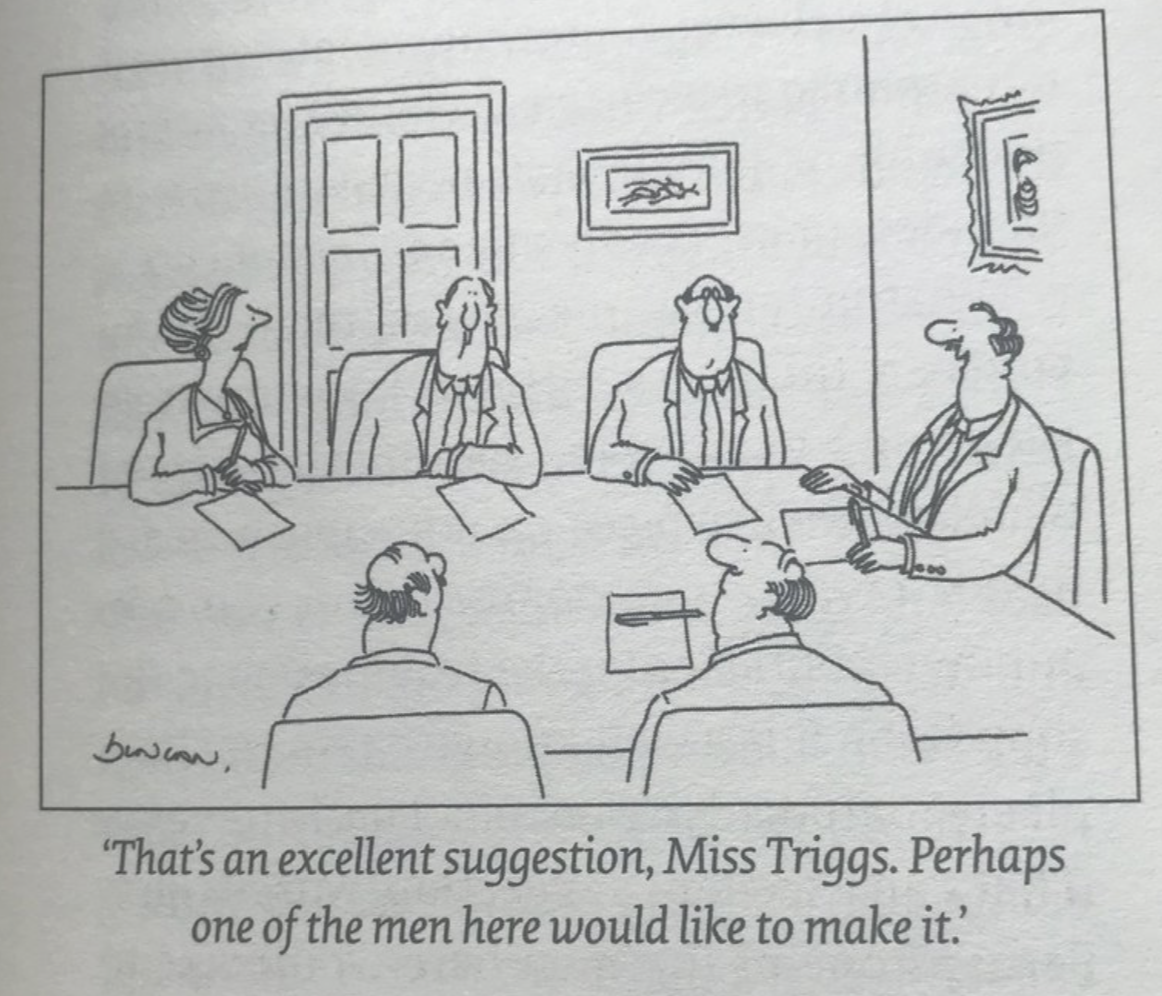
Riana Duncan in Punch Magazine from 1988, as true now as ever.
Next up: A deep dive into The Coaching Habit and Surrender to Lead to see how behavioral science holds up on the executive floor.
Books referenced:
Bungay Stanier, Michael. (2016). The coaching habit: Say less, ask more & change the way you lead forever. Toronto: Box of Crayons Press.
Duckworth, Angela. (2016). Grit: The power of passion and perseverance. New York: Scribner.
Fisher, Roger, Ury, William, & Patton, Bruce. (2011). Getting to yes: Negotiating agreement without giving in (Rev. ed.). New York: Penguin Books.
Kriegel, Jessica & Terry, Joe. (2026). Surrender to lead: The counterintuitive approach to driving extraordinary results. Washington, DC: Amplify Publishing.
Maxwell, John C. (2019). Developing the leader within you 2.0. Nashville: HarperCollins Leadership.
Rodriguez, Rodrigo. (2025). Negotiate without guilt: How to ask for what you deserve, set boundaries, and handle pressure without damaging relationships. Independence: Independently published.