Surrender to Lead Review: Keep the Results Formula, Skip the Surrender
Surrender to Lead is really two books in one: a faith-based message about surrendering control over outcomes, and a practical framework for aligning purpose, strategy, and culture that is the reason to read it. Its evidence comes mainly from the authors' own success stories, so treat the Results Formula as a useful organizing tool rather than a proven method.
Surrender to Lead by Culture Partners’ Chief Strategy Officer Jessica Kriegel and CEO Joe Terry, is two books in one. The first is about surrendering control over outcomes to faith, a message that will resonate with some readers and not with others. The second is a practical guide on how to align organizational purpose, strategy, and culture to drive results. This second part is the reason to read the book: drawing on decades of experience consulting with Fortune 500 companies and rapidly growing tech businesses, this book will be especially useful for leaders at organizations whose purpose and vision have become too detached from day-to-day actions.
With lineage traceable to the 1994 bestselling business book, The Oz Principle by Roger Connors, Tom Smith, and Craig Hickman, Surrender to Lead shares the familiar message of personal and organizational accountability being requisite to achieving success. Connors and Smith co-founded Culture Partners, now under Terry's and Kriegel’s leadership. The Oz Principle divides actions into two camps: those above the line and those below the line. Those above the line (ownership, accountability, action) will shepherd in success, and those below the line (blame, excuses, denial) trap individuals and organizations in a victimhood cycle. A heaven and hell, if you will.
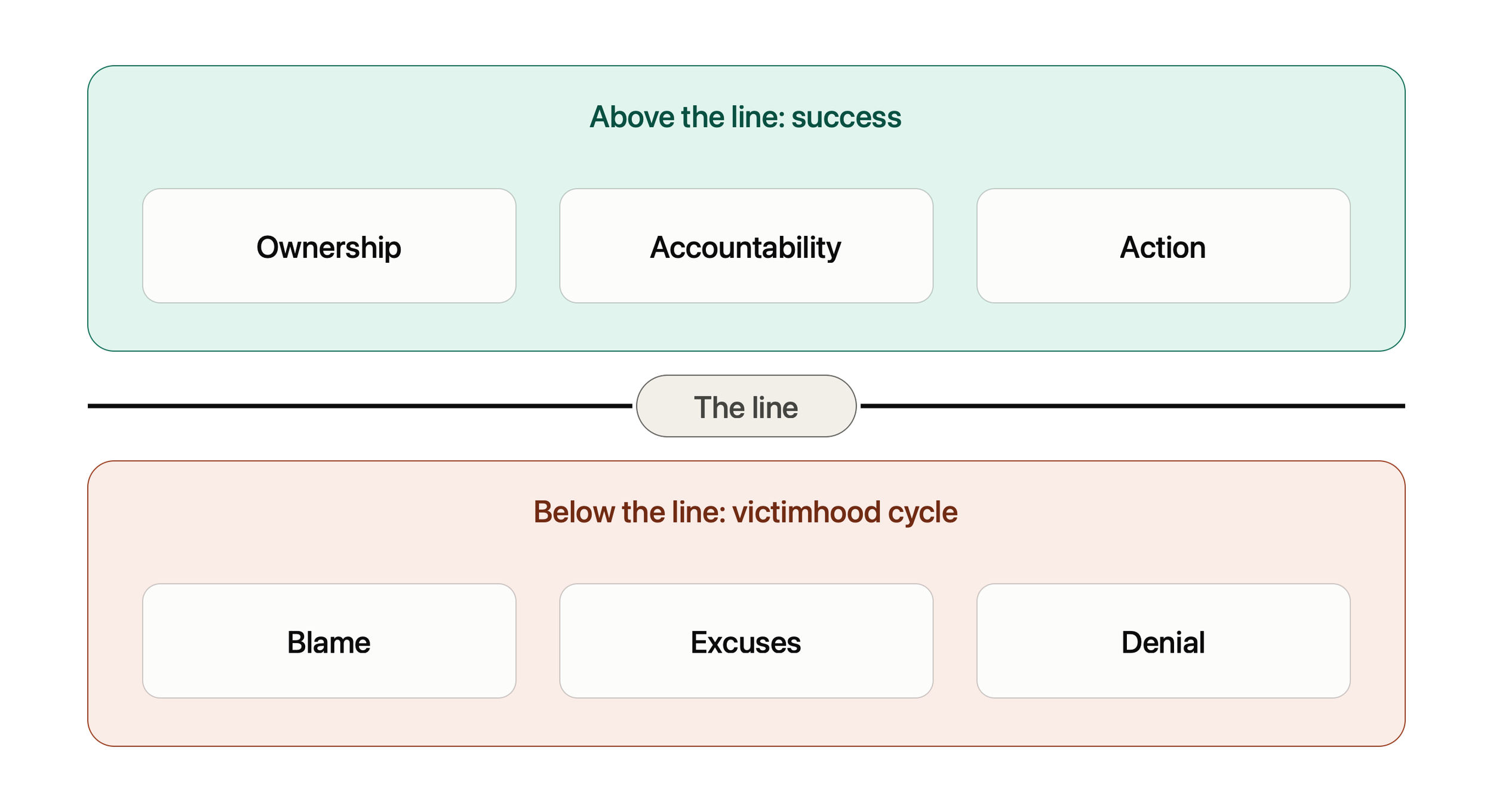
Framework from The Oz Principle (Connors, Smith, and Hickman, 1994)
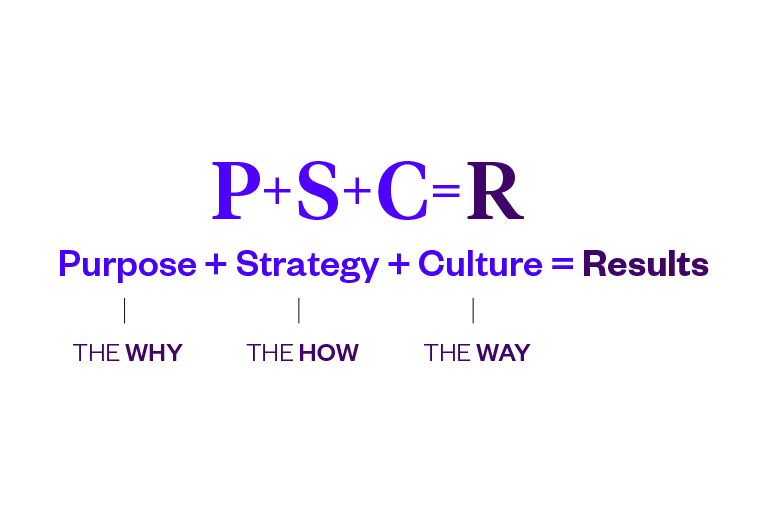
As with The Oz Principle, Kriegel and Terry's Surrender to Lead borrows from their religious faith at times to make their point. Faith is central in Kriegel and Terry's telling of their personal stories of how they surrendered control over their professional lives (e.g., "I'm responsible for the effort. God is responsible for the outcome. That's surrender."). Like the quote above, I found the book to consist of two parts. The first is that God is responsible for the outcome and we do best to surrender to it. Fair enough. There is excellent research on the ways that religious belief compensates when personal control is low, specifically by reducing the anxiety in the believer that is caused by uncertainty. The second, far more useful part, is a very practical explication of Culture Partners' Results Equation: Results = Purpose + Strategy + Culture.
As Kriegel and Terry did, I'll best summarize this with an example. Your company first needs to identify a clear result it is looking for. Let's imagine that result is 150% growth by 2030. Next it needs to bring into alignment purpose, strategy, and culture. Why do you want that 150% growth? Because you believe your product will have a positive impact on people, your purpose is to impact the lives of 30,000 more people. How will you then do that? The strategy is going to be the roadmap to adding those clients by 2030. Finally, and this is where Kriegel and Terry are most insightful, you need to shift your company culture.
How you shift your culture and align it to current goals, purpose, and strategy is the trickiest part, and Kriegel and Terry are right to say so because culture consists of everything from the environment to beliefs and experience. Culture is everything employees think and do. Do you have a culture where employees can seek feedback? Or do you have a culture where employees avoid speaking up for fear of getting punished for mistakes? taking our example of a company looking to grow, fostering a culture where employees can speak up, employees will be able to collectively reach result of 150% growth by 2030. Leaders can shift culture by getting closer to the work, being specific about their vision and purpose, and recognizing when employees are embodying the new culture.
Kriegel and Terry’s emphasis on setting specific, measurable goals echoes over 50 years of empirical work led by Edwin Locke and Gary Latham on Goal Setting Theory. The book doesn't lay out this research, but it helps explain why their advice works. Locke and Latham identify four mechanisms through which goals affect performance:
Directive: Goals direct attention and effort toward what is relevant and away from what is irrelevant.
Energizing: People put more effort into harder goals than easy ones.
Persistence: Goals keep people on task and let them regulate intensity.
Strategy and knowledge: Goals shape what knowledge and skills people consider relevant and how they search for new information.
(Locke & Latham, 2002)
Providing feedback is a central part of both Surrender to Lead's approach and Goal Setting Theory. Researchers elaborate an implied distinction between feedback on process versus feedback on outcome. Feedback on process motivates people to do more information search or develop strategy, while feedback on outcome boosts self-confidence and effort. In sum, both are needed. Similarly, Kriegel and Terry remind us that leaders need to share not only what a person did right, but how they did it and how it relates to the company's culture and vision.

When a surviving war plane return from battle, engineers might think reinforcement is most needed around the red dots, where the plane was hit. The survivorship bias is that we don’t know where the planes were hit that never returned.
Ultimately, the weakness of the book is that it relies on Culture Partners’ own success stories. This is a case of survivorship bias, where you focus only on the examples which succeeded, rather than those that failed. The classic illustration comes from World War II, when engineers wanted to reinforce the areas with the most bullet holes on returning bombers. The statistician Abraham Wald saw the flaw: planes hit elsewhere never came back to be counted, so the unmarked areas were the ones that needed armor. The results equation isn’t compared and vetted against other approaches, and we don’t know the circumstances of cases where it wasn’t successful. Together, these gaps makes it difficult to pinpoint exactly what makes the Results Equation work, and if it would work for your organization.
Even so, Surrender to Lead earns its place. The best idea it shares, that culture shifts when leaders get close to the work, are specific about what they want, and recognize people who embody it, lines up with what the goal-setting and feedback research would predict. For leaders who want a practical way to connect a growth target to daily behavior, it's a worthwhile read.
References and Further Reading:
Earley, P. C., Northcraft, G. B., Lee, C., & Lituchy, T. R. (2019). Impact of process and outcome feedback on the relation of goal setting to task performance. Academy of Management Journal, 33(1), 87-105. https://doi.org/10.5465/256353
Hoogeveen, S., Wagenmakers, E.-J., Kay, A. C., & Van Elk, M. (2018). Compensatory control and religious beliefs: A registered replication report across two countries. Comprehensive Results in Social Psychology, 3(3), 240-265. https://doi.org/10.1080/23743603.2019.1684821
Kay, A. C., Gaucher, D., McGregor, I., & Nash, K. (2010). Religious Belief as Compensatory Control. Personality and Social Psychology Review, 14(1), 37-48. https://doi.org/10.1177/1088868309353750
Locke, E. A., & Latham, G. P. (2002). Building a practically useful theory of goal setting and task motivation: A 35-year odyssey. American Psychologist, 57(9), 705-717. https://doi.org/10.1037/0003-066X.57.9.705